TL;DR — WalkFirst is out now on the App Store. It blocks the apps that eat your time until you reach your daily step goal — powered by Apple's Screen Time framework and Apple Health, fully on-device.
Today I'm launching WalkFirst, my new iOS app that turns your daily steps into screen time. You pick the apps that distract you, set a step goal, and those apps stay locked until you've walked enough. Want to scroll? Go earn it.
The idea came from a problem I couldn't fix with willpower: reach for the phone, open Instagram, lose twenty minutes before my feet touched the floor. It wasn't really a discipline problem — it was a friction problem. Scrolling was effortless, walking took effort, so the effortless thing always won. Every screen-time tool I tried either relied on me pressing "remind me in 15 minutes" (I always did) or punished me with streaks and shame. None of them changed the physics of the situation.
WalkFirst changes the physics. No streaks, no motivational quotes, no shame mechanics — just a simple trade: steps in, screen time out.
What it looks like
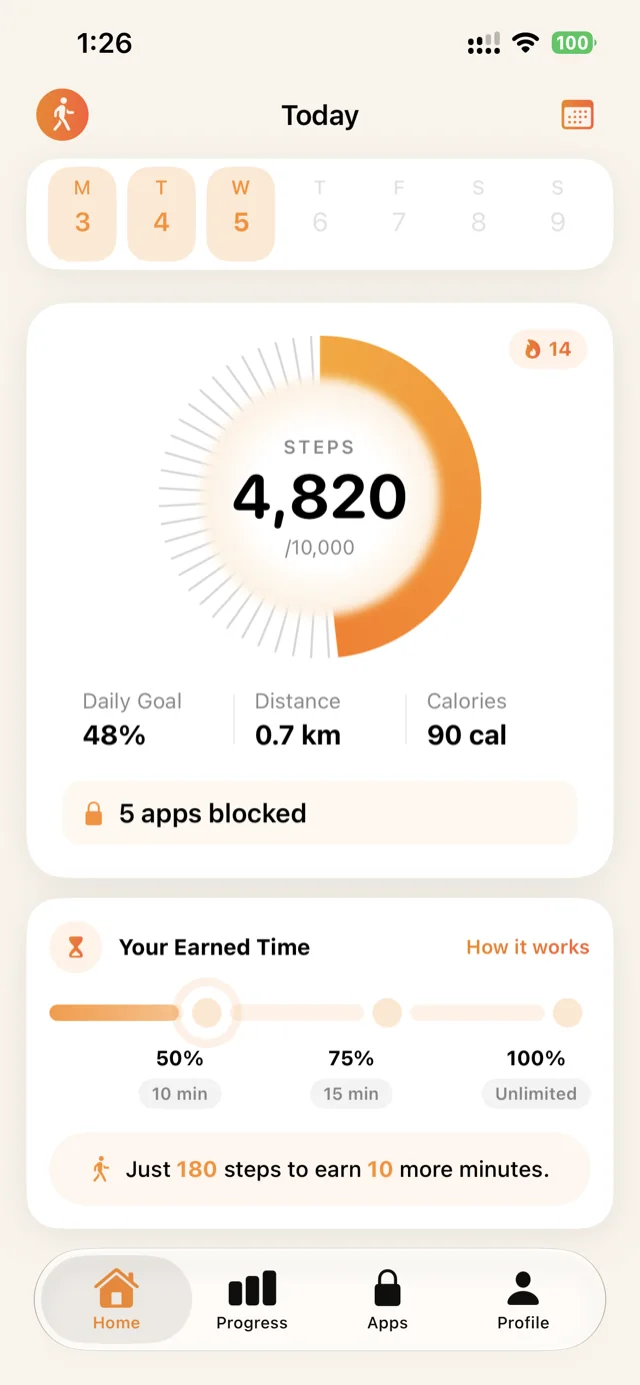
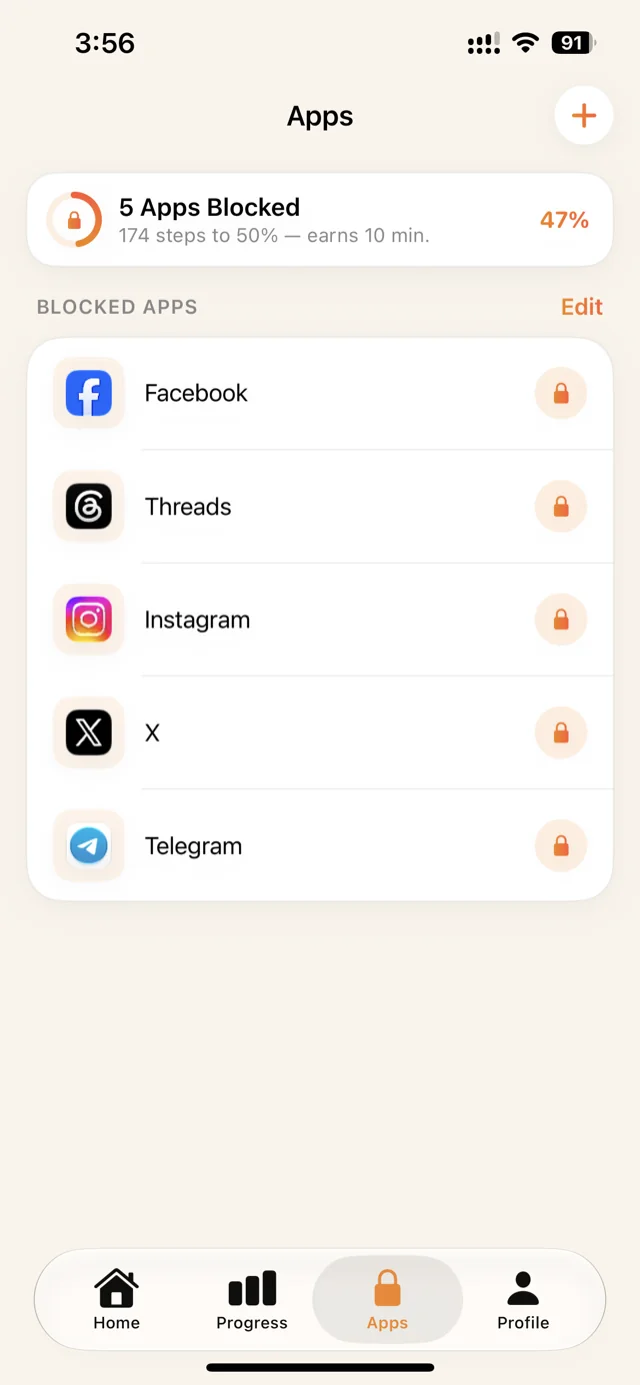
The home screen is a single progress ring — your steps today against your goal, with your earned screen time below it. The apps screen shows what's currently shielded. That's the whole app. If you're checking WalkFirst more than twice a day, I've failed at the design.
How it works under the hood
WalkFirst is built on two Apple technologies that rarely get used together:
- Screen Time (FamilyControls) — the same framework behind iOS parental controls, and the only legitimate way to actually block apps on iOS. It requires your explicit permission, and when you're short of your goal, your chosen apps show a shield instead of opening. Getting the shield experience right meant building custom Shield UI and Shield Action extensions — a corner of iOS very few apps ever touch.
- Apple Health — your steps come straight from the Health app, counted by your iPhone or Apple Watch. As you walk, WalkFirst tracks your progress, and the moment you cross your goal, the shield lifts.
The best part of this architecture: everything happens on your device. WalkFirst has no account system and no server storing your data. I never see your step count, and I can't even see which apps you've blocked — Apple's framework keeps that private by design. That's not a marketing line; it's how the system physically works.
Why steps?
Because walking is the one habit almost everyone agrees they want more of, and it's binary — you either walked or you didn't. There's no gaming it from the couch. And it creates a genuinely fair exchange: on a day you walk 8,000 steps, you've earned your downtime. On a day you don't, your phone gently reminds you that the outdoors exists.
Availability
WalkFirst is available worldwide on the App Store for iPhone, free to download with a Pro upgrade for the full experience — as a subscription or a one-time lifetime purchase, whichever you prefer. There are widgets for your home screen, haptics when you hit your goal, and localizations in English, German, Spanish, French, Japanese, and Korean.
Built solo, built to last
I'm a solo developer — WalkFirst is designed, coded, and supported by one person. That means the app stays small, fast, and focused: no ads, no bloat, no dark patterns. If something breaks, the person reading your support email is the person who wrote the code. If you have feedback or a feature idea, I'd genuinely love to hear it.
WalkFirst is available now on the App Store.
Walk more, scroll less.